
Build a Sustainable Business That Supports Their Life not Drains You.
- Ana Lilia

- Jul 18
- 7 min read
Updated: 5 hours ago


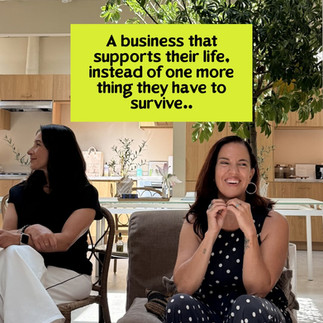


How to have recurring revenue in your business so you can live your life too.
My first gathering had four people in it.
Four. In a room that could have held forty. I had spent two weeks writing the invitation and about ten minutes wondering if anyone would come, which is the ratio you use when you are trying not to think about something.
Five years later I've generated over a million dollars in sales without spending a dollar on ads, sold out retreats seven years running, and filled a room with a hundred people.
And last year I hit empty anyway.
I want to start there, because most people writing about business models don't. I'm a solo entrepreneur whose entire business is built on holding space for other people, and I ran out of the thing I was giving away. Perimenopause arrived in the middle of it and rearranged the furniture. I was the breathwork facilitator who couldn't regulate her own nervous system.
So when I tell you that community is the most sustainable way I know to build a business, I'm not telling you it's effortless. I'm telling you what actually held when I couldn't.
The short answer
Recurring revenue for a coach or healer doesn't come from making more content. It comes from building a gathering.
A signature gathering is a repeatable event — online or in person — that the same people return to. It builds trust faster than content because people experience you directly rather than reading about you. A percentage of attendees move into your paid offers. Those clients refer others, because they've been in a room with you and they can describe what it's like. And the gathering runs again next month.
That's the whole mechanism. You build it once, then refine and repeat. The revenue becomes predictable because the source of it is a system, not a launch.
I call this the Community Revenue Engine, and the rest of this post is how it works.
The question underneath the question
The conversations in my DMs have changed over the past year.
The women writing to me aren't asking how to get more clients. They have clients. They're making money. On paper, it's working.
They're asking something more honest:
How do I build a sustainable business that stops asking more of me every single year?
Because that's the part nobody warns you about. You solve the client problem and discover it wasn't the problem. The business keeps needing more. More time, more energy, more output. And no matter how much it grows, it never quite stabilizes underneath you.
What they're describing isn't a marketing issue. It's a structural one.
Why most coaching businesses stay stuck here
Almost every business model taught to coaches and healers runs on the same engine: constant visibility, constant content, constant output.
Which means the business only works while you're working.
That's not a discipline problem or a mindset problem. It's arithmetic. If revenue is a function of how much you post and how many hours you're available, then the only lever you have is you. Growth doesn't change the structure. It just makes the structure heavier.
I know the shape of this intimately, and not only from my business.
I'm the eldest daughter of Mexican immigrant parents. I learned early that being useful is how you stay safe. My mother stood at the stove heating tortillas one at a time so the rest of us could each have a warm one, and by the time she sat down her own food was cold, and she never once mentioned it. My father hid a forty-ounce beer under the back porch stairs, and I became expert at reading a room before I was old enough to read a book.
That wiring builds a very effective business. It also builds one that requires your total presence to survive, because you never learned that anything could hold without you inside it holding it.
So when I say the model has to change, I mean something more specific than "work smarter." I mean the structure has to be capable of running when you are tired, or sick, or in Mexico visiting your family, or forty-five and negotiating with your own body.
What community does that content can't
Content produces an audience. An audience watches.
Community produces something else. People who stay, come back, and bring others with them.
The functional difference is where the trust lives. In a content model, trust accumulates in you personally — every new person has to be convinced from zero, by you, again. In a community model, trust accumulates in the room. Members vouch for you to people you've never met. They collaborate with each other. They refer, not because you asked, but because they were there and they can describe it.
That's the shift from an audience that consumes to an ecosystem that circulates. Opportunities start moving inside it without passing through your hands first.
This model isn't new, incidentally. It's older than any of us. Long before funnels and follower counts, trust was built in rooms — through presence, consistency, and people who kept showing up. Your grandmother knew this. Somewhere along the way the online space traded that depth for visibility and taught us to perform for strangers instead of tending the people already drawn to us.
The Community Revenue Engine
Five parts. In order.
1. Clarify your promise. Before anyone will give you an hour of their evening, they need to understand in one sentence what they're stepping into. Not your modality. Not your credentials. What changes for them in that room. Most gatherings that fail to fill don't have an attendance problem — they have a clarity problem.
2. Host your signature gathering. One event, online or in person, designed for trust rather than sales. It's the same gathering each time so it can compound. A workshop, a circle, a class, a salon. Five to fifteen people is a real gathering. I started with four.
3. Extend a clear invitation. At the end, people are told what exists next and how to step into it. Not a pitch. An invitation, given plainly, by someone they've just spent ninety minutes with. This is the step most healers skip, and skipping it is why gatherings that feel wonderful generate nothing.
4. Follow up as leadership. The experience continues after the room closes. You reach out because you're leading something, not because you're chasing someone. There's a real difference and people can feel which one they're receiving.
5. Build retention and referral. You design deliberately for people staying and bringing others. This is the part that makes growth compound instead of resetting to zero every month.
Build it once. Then refine and repeat.
The math
This is where I want to be precise, because our industry is full of income claims and I'm not going to add to them.
I'm not going to tell you what you'll earn. I don't know your audience, your pricing, or your capacity. What I can show you is the arithmetic, so you can run it against your own numbers:
25 people at a $55 workshop → $1,375
10 people in a $995 group program → $9,950
8 retreat deposits at $1,500 → $12,000
None of these require a large following. They require a gathering that builds trust and an offer ladder that gives people somewhere to go next.
Two coaches I've taught this model to, for context on what it looks like in practice. Rebecca had promoted a retreat for three months with zero sales — the offer was strong, the positioning wasn't reaching the right people. We rebuilt the messaging and she sold eight spots, $32,000. Norma had the expertise but no model; we built her free community and thirty people joined in the first few days, then she funneled them into her paid program at launch. Their results are theirs, produced by their work. What they had in common was the structure.
Run the numbers on your own situation before you take anyone's word for anything, including mine.
But my audience is small
Good. Small is where this works best.
You don't need a large following to build something meaningful. You need access to people. A modest email list, past clients, local connections, collaborators. The first win usually looks like five to fifteen humans in a room, and that is where every lasting community begins.
Four people, in my case. I've now watched enough of these get built to say with confidence that the size of the first room predicts almost nothing about what it becomes.
But I'm an introvert
Introversion and leadership live together beautifully.
Community isn't built on charisma. It's built on clarity and consistency, and both are learnable regardless of how you're wired. Some of the most magnetic gatherings I've been in were led by quiet people who were simply very clear about what they were offering and showed up every single month without fail.
Several of the women I've worked with came in convinced they weren't the kind of person people gather around. What they were missing wasn't personality. It was a model and some support.
But I tried this before and it didn't work
Then you probably hosted an event rather than building a system.
A one-off gathering with no repeat, no clear invitation at the end, and no follow-up structure produces a nice evening and nothing else. That's not a failure of your ability to gather people. It's an incomplete engine — usually missing steps three, four, and five.
The gathering is the beginning of the model. It isn't the model.
Questions I get before people start
What is a community-based business model? A business model where a recurring gathering — not content volume — is the primary way you build trust, generate clients, and produce referrals. Revenue comes from converting gathering attendees into paid offers and retaining them over time.
How do I create recurring revenue as a coach? Build one repeatable gathering that the same people return to, create a clear offer for attendees to step into afterward, and design deliberately for retention and referral so growth compounds rather than resetting each month.
How many people do I need to start a community? Five to fifteen. A gathering of five real people with clear intent generates more revenue and more referrals than a large passive audience.
Does this work if my audience is online? Yes. A signature gathering can be virtual, in person, or both. The mechanism is direct experience of you, not physical proximity.
How is a community different from an email list or a following? A following consumes what you make. A community forms relationships with each other, which means trust accumulates in the room rather than resting entirely on you.
Where to start
I'm offering a complimentary 30 minute audit and we'll look at what gathering would make sense for what you've already built. book a free 30-minute call
One question before you go, and I'd like to hear the answer in the comments:
What's the smallest gathering you could host this month?
Not the impressive one. The smallest one.
Because that's usually the one that actually happens.
xo Ana


Comments